The 1960s were a time of social and political upheaval in Bermuda. The June 1959 Theatre Boycott was still fresh in people’s minds and racial segregation in the community and companies, including BELCO, was still a part of everyday life for many of Bermuda’s workers.
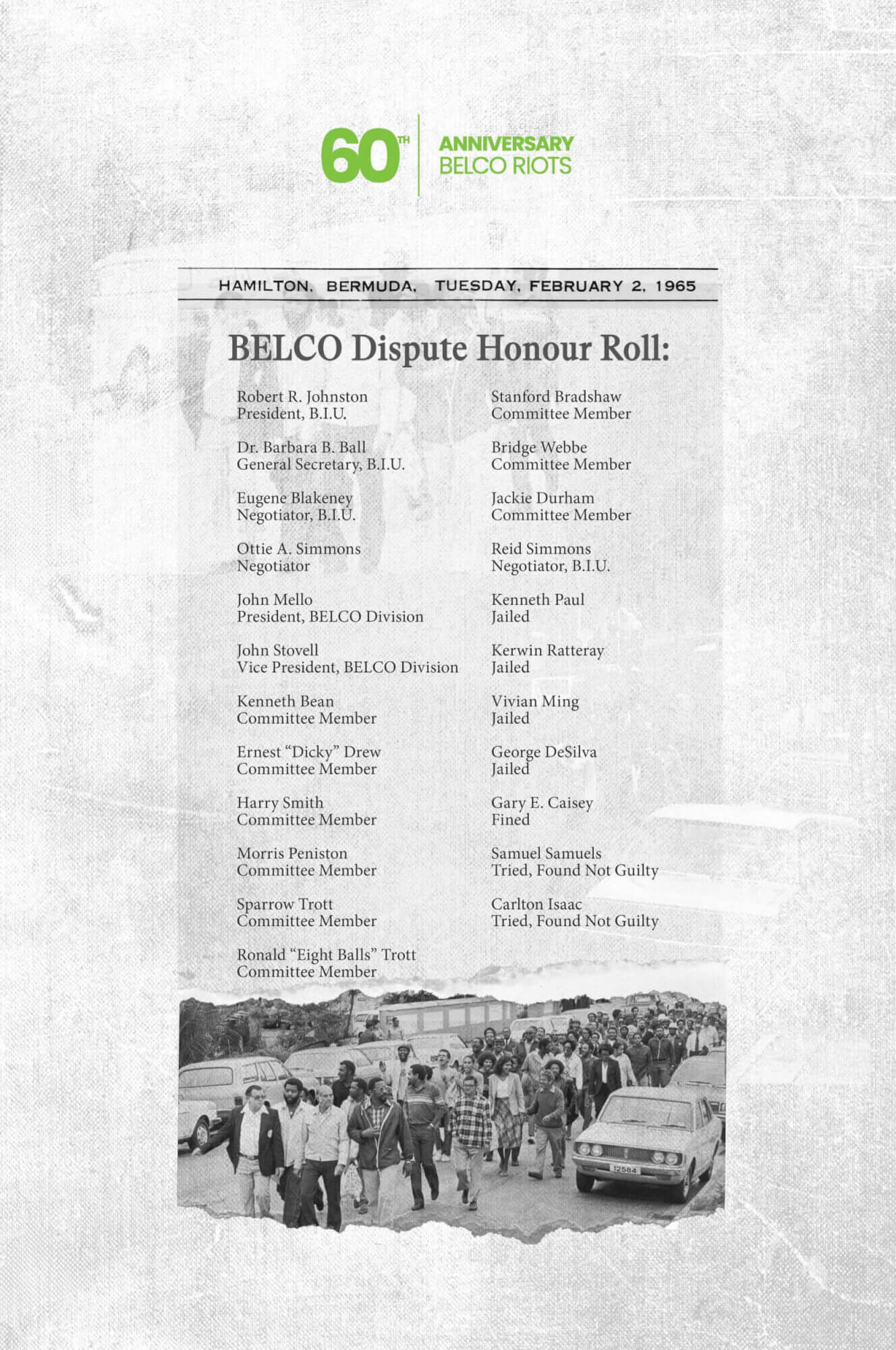
In January 1965, a labour dispute was initiated involving approximately 90 of BELCO’s outside-plant employees, including lineworkers, garage mechanics, drivers, labourers and maintenance personnel, who had sought union recognition and had recently organised into the B.I.U.
A written application for union recognition was submitted to BELCO management and rejected. In addition, efforts by Government’s Labour Relations Officer (LRO), Harold Chudleigh, failed to resolve the dispute between management and the workers.
At the time, BELCO’s directors and shareholders were some of Bermuda’s most powerful men including Sir Harry Butterfield, Sir John Cox, Sir Henry (Jack) Tucker and Sir Bayard Dill who, along with BELCO General Manager, Llewelyn Vorley, were the Company’s representatives in negotiations. The B.I.U. was represented by Dr. Barbara Ball, General Secretary; Eugene Blakeney, Assistant General Secretary; Robert Johnston, President; Ottiwell Simmons, Union Organiser; and a delegation of electrical workers.
Following a union sponsored public relations campaign, BELCO management agreed to hold a ballot for staff provided that all 231 employees participated with a requirement that 60% voted in favour before the Company would grant union recognition.
The Union rejected the ballot proposal as recognition votes were ordinarily determined by a simple majority. It was also felt the inside workers, who were mostly white, would vote against union recognition.
Meetings and mediation with the LRO were held but talks broke down. The final straw was when BELCO’s board chairman and chief negotiator, Sir John Cox, embarked on a trip to England and none of the negotiating team would meet without him.
As a result, on January 13, 1965, the Union’s Electrical Division held a secret ballot for strike action which was 55 in favour and two against. Support was received from the non-unionised Bermuda Telephone Company staff who said they would strike in support of the Electrical Division if necessary.
At a general meeting of all Union members on Monday, January 18, 300 members expressed full support to strike in sympathy with the Electrical Division. The following day, strike action commenced with 80 of 97 workers setting up picket lines at BELCO’s Serpentine Road headquarters. Enthusiasm was high that there would be a swift resolution to the dispute.
The workers on strike enjoyed a jovial atmosphere, joking about their bosses, singing and playing instruments and marching in unison in front of the Company gates. By the third day, with no movement from BELCO management, picket lines were set up at the St. George’s office.
By January 23, a picket line had also been established at BELCO’s bill collection office on Reid Street, Hamilton. It was believed that this caused the police to order that the picket line be broken up.
The first incident involved a police constable who hit and pushed Harry Smith, an outside-plant Foreman. Mr. Smith reacted with equal force, but the incident was soon quelled. The picketers were determined to fight for their legal right to peacefully picket Company headquarters.
Mr. Ottiwell Simmons recalled in his memoir “Gateboy” that before this strike, there had never been industrial action that had the potential for an all-out explosion of attitudes, emotions and physical confrontations. He said BELCO symbolised the power and influence that had been handed down through generations of the slave-master era. While the workers were determined to win union recognition, the BELCO directors and shareholders were the same people who made up the Government, the owners and operators of the banks and legal firms as well as The Royal Gazette. They were also able to influence the armed forces and police and did so.
The Union continued to hope for a resolution, but the Company attempted to break the strike by intimidating B.I.U. members to return to work. While a handful of staff succumbed and returned to work, this only caused stress and tensions to increase. The police became more aggressive and started to harass the picketers in the hope they would retaliate and give them an excuse to break the strike using physical force.
On January 26, a police car knocked down Bro. Charles Dowling, injuring his leg which required hospital treatment. A complaint to the police went unanswered. The Union responded by warning that continued provocation by the police may result in retaliation by picketers. Union members also demanded their representatives apply more pressure on the Company by calling out other workers to join the strike.
During this time there were reports of malicious damage to BELCO infrastructure involving damage to a transformer at Knapton Hill, an attempt to hack through a cable at the Sonesta Beach Hotel and an attempt to set a pole on fire in Hamilton.
On January 27, the B.I.U.’s Health Division responsible for garbage collection and the Construction Division, discussed sympathy strikes, and a new picket line was established at BELCO’s Somerset branch.
Negotiations had stalled and there was a meeting on January 28 attended by 300 people and another on January 31 at Devonshire Recreation Club attended by more than 450 members. It was decided that on February 2, after 30 days on strike, that no one would be allowed to cross the picket line to leave or arrive for work. An estimated 400 workers had joined the picket line as well as an increased police presence and tensions were running high.
Shortly after 8am police in riot gear positioned themselves near the junction of Serpentine Road and Rosemont Avenue and arrested eight workers and took them to Hamilton Police station. Within the picket line, the strike reached a boiling point when strikers and police clashed violently, with injuries, some severe, on both sides.
Ottiwell Simmons recalled that the scene resembled a war zone, with some picketers bloodied and dazed, arrests were being made, a police van was overturned and someone tried to set it alight with the leaking fuel. Police fired gas canisters, forcing the picketers to retreat as the air was filled with riot gas. Dr. Barbara Ball was on the scene treating the injured, and picketers began to flee and escape to safety at Devonshire Recreation Club. Workers from all over the island gathered at the Club with many armed with knives, iron bars and even fire arms as they heard police intended to make further arrests.
The Hon. Hugh (Ryo) Richardson, sympathetic to the strike, called Governor Lord Martonmere and urged him to stop police storming the club as he feared it would result in deaths. The Governor stopped the police from entering the club as more workers gathered to assess the situation. Meanwhile, Robert Johnston and others who had been arrested were charged in court with unlawful assembly, besetting premises and obstruction, was found guilty and fined 300 pounds to be paid immediately. Johnston refused to pay a penny and was locked up. However, the magistrate later said he had erred in demanding immediate payment and he was released to re-appear at a later date. Johnston, along with a large crowd that had assembled, returned to Devonshire Recreation Club where they all stayed for more than a week.
During this time negotiations continued with the Government Negotiations failed to progress and the Government called the Colonial Office in London who dispatched Mr. George Foggan to assist. Mr. Foggan had a respectable reputation with both unions and employers throughout the Commonwealth and had successfully resolved disputes in England and the colonies. The B.I.U. called on the National Workers Union of Jamaica who sent their president, Mr. Tussey Kelly, who, along with the Governor, tried to mediate a settlement.
After long negotations, an agreement was reached on February 19 with workers returning to work on February 22. However, six staff were made redundant as part of the agreement.
It was also clear to the B.I.U. that an agreement to hold a secret ballot would result in a rejection of joining the Union. As a result, BELCO encouraged staff to form their own union, the Electrical Supply Trade Union (ESTU) and it’s first president was Chuck Renaud.
The B.I.U. protested the formation of a new union but in a vote supervised by the LRO, BELCO workers voted 137 in favour of the ESTU and 94 in favour of joining the B.I.U.
The Electricity Supply Trade Union established the required majority and was granted recognition and sole bargaining rights.
The ESTU celebrates 60 years in 2025 and represents approximately 204 staff from BELCO and IFM. They remain committed to their Mission Statement which reads in part: “The Electricity Supply Trade Union is a Union run by its members. As such we are a democratic organisation dedicated to ensuring the welfare of its membership and the furtherance of Trade Unionism.”
Sources:
Adapted from The History of the B.I.U. by Ira Phillp.
ESTU: http://estu.bm/